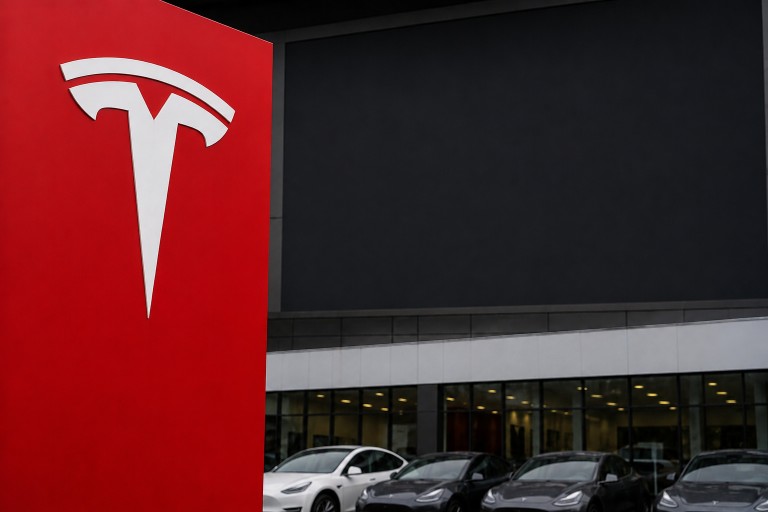
Tesla’s financial performance for the second quarter fell short of Wall Street’s profit expectations, despite the company achieving higher-than-anticipated revenue. This disparity led to a more than 3% decline in Tesla’s stock during after-hours trading. Specifically, the electric vehicle manufacturer reported earnings of 31 cents per share, which was significantly below the 51 cents per share that analysts had forecasted. On the other hand, Tesla’s revenue amounted to $28.23 billion, exceeding the predicted figure of $25.71 billion.
The company’s stock has decreased by approximately 14% this year, attributable to the mounting competition from more affordable Chinese electric vehicle companies and the repercussions of the cessation of U.S. electric vehicle tax incentives. Although electric vehicle sales continue to be a vital component of Tesla’s business, the company is increasingly pivoting towards technological innovations such as artificial intelligence, robotics, autonomous driving, and its emerging Robotaxi service. Elon Musk, Tesla’s CEO, emphasized the potential of the Optimus humanoid robot, suggesting it could become the company’s most significant product in the future, although he acknowledged the substantial technical and manufacturing hurdles that need to be overcome before it can be produced on a large scale.
In addition to its focus on robotics, Tesla is broadening the reach of its Robotaxi service, introducing it to new areas including Tampa and Orlando. The service, which offers autonomous ride-hailing, is already operational in selected regions of Austin, Dallas, Houston, and Miami. Musk has underscored that the expansion of the Robotaxi service is being handled with caution, emphasizing safety and the avoidance of incidents that could lead to increased regulatory scrutiny.
Currently, around 50 Robotaxis are in operation in Austin, the location where the service initially launched. As Tesla continues to develop its autonomous driving capabilities, the company remains vigilant in its approach, ensuring that safety remains a top priority during the rollout process.