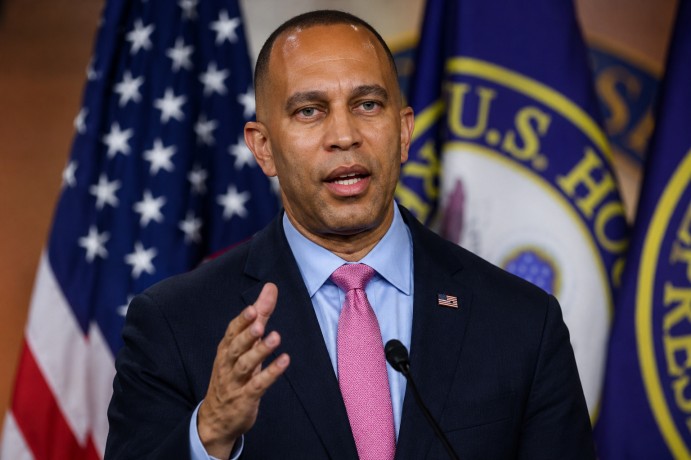
In a move that underscores internal divisions within the Democratic Party, senior members have vowed to oppose a Republican-led proposal aimed at halting $3.3 billion in U.S. aid to Israel. The amendment, introduced by Representative Thomas Massie, has been described by House Minority Leader Hakeem Jeffries as “overly broad.” Jeffries expressed concerns that such a measure could inadvertently disrupt humanitarian efforts and undermine initiatives to counteract militant entities like Hamas and Hezbollah.
House Democratic Caucus Chair Pete Aguilar also stands against the proposal, while still recognizing the need to reevaluate U.S.-Israel relations. Aguilar noted that current Israeli policies have played a role in its increasing regional isolation. Meanwhile, the debate highlights a growing call within the party to reassess America’s stance on Israel amid ongoing tensions in Gaza.
On the other side of the debate, Greg Casar, Chair of the Congressional Progressive Caucus, has urged lawmakers to back the amendment. Casar argues that U.S. taxpayer dollars should not continue to support Israel’s military actions, suggesting that it’s time for the Democratic Party to adopt a different approach towards the Israel-Palestine conflict.
Amidst these differing perspectives, Jeffries is advocating for what he terms a “major reset” in U.S.-Israel relations. He supports Israel’s right to exist and simultaneously calls for the establishment of a Palestinian state. Jeffries further suggests that future U.S. military assistance should align with human rights benchmarks and take into account Israel’s capacity to shoulder more of its defense expenses independently.
The discussion within the Democratic Party takes place as pressure mounts from both voters and progressive legislators demanding policy changes regarding U.S. support for Israel. This internal debate is reflective of broader shifts in attitudes toward the complex geopolitical landscape of the Middle East.